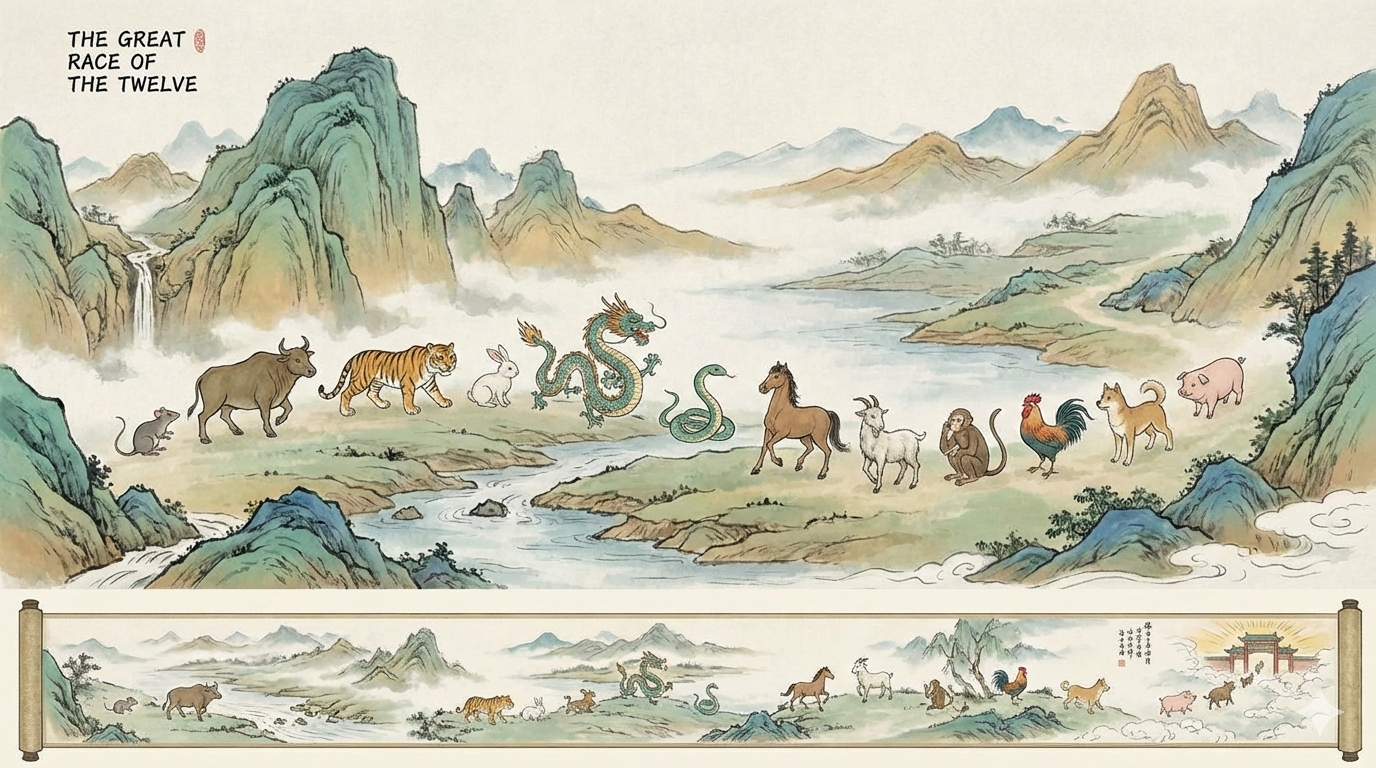
Every Lunar New Year, as red lanterns sway and family tables fill with symbolic dishes, conversation inevitably turns to the animals: Are you a Dragon? A Rabbit? A Horse? The Chinese zodiac, at once mythic, mathematical, and deeply personal, remains one of the world’s most enduring cultural systems. But beyond the placemats and party trivia lies a layered history shaped by astronomy, folklore, imperial timekeeping, and a legendary race that still defines the order of the animals today.
The Origin of the Chinese Zodiac
Known as Chinese zodiac (生肖, shēngxiào), the system dates back more than 2,000 years, with roots in the Han dynasty’s calendrical science. Ancient Chinese astronomers divided time into 12-year cycles aligned with the orbit of Jupiter, often called the “Year Star.” Each year was symbolized by an animal, creating a repeating pattern that was easy to remember and rich in metaphor.
The zodiac was woven into the broader framework of the Chinese calendar, a lunisolar system balancing the moon’s cycles with the solar year. Timekeeping was never just practical, it was cosmological. Years, months, days, and even hours were assigned earthly branches, each linked to an animal, element, and yin yang polarity. Destiny, in this worldview, was not random; it moved in rhythm.
The Great Race: Why the Animals Are in That Order
If the calendar provided the structure, folklore supplied the soul.
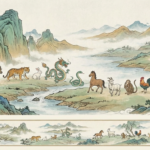
According to legend, the Jade Emperor ‘ruler of heaven’, announced a race across a great river to determine which animals would earn a place in the zodiac, and in what order. The story is playful, but its lessons are pointed. It was a test of character.
1. Rat – Small but shrewd, the Rat knew it could not outswim the larger beasts. It persuaded the Ox to carry it across, then leapt ahead just before the finish line. First place was claimed not by strength, but by strategy, an early nod to intelligence and adaptability.
2. Ox – Patient, steadfast, and hardworking, the Ox would have won had it not been for its generosity. It embodies endurance and quiet leadership, the kind that carries others without complaint.
3. Tiger – A symbol of courage, the Tiger battled fierce currents, arriving breathless yet triumphant. Its third-place finish honors bravery and raw determination.
4. Rabbit – Light-footed and clever, the Rabbit darted across stepping stones and driftwood, nearly slipping into the river. Its place reflects elegance under pressure and creative survival.
5. Dragon – The only mythical creature in the zodiac, the Dragon could have flown straight to victory. Instead, it paused mid-race to bring rain to drought-stricken lands and help villagers in need. Arriving fifth, the Dragon’s delay is a testament to benevolence over ego power tempered by compassion.
6. Snake – Quiet and calculating, the Snake coiled unnoticed around the Horse’s hoof and startled it near the shore, slipping into sixth place. Intuition and timing proved decisive.
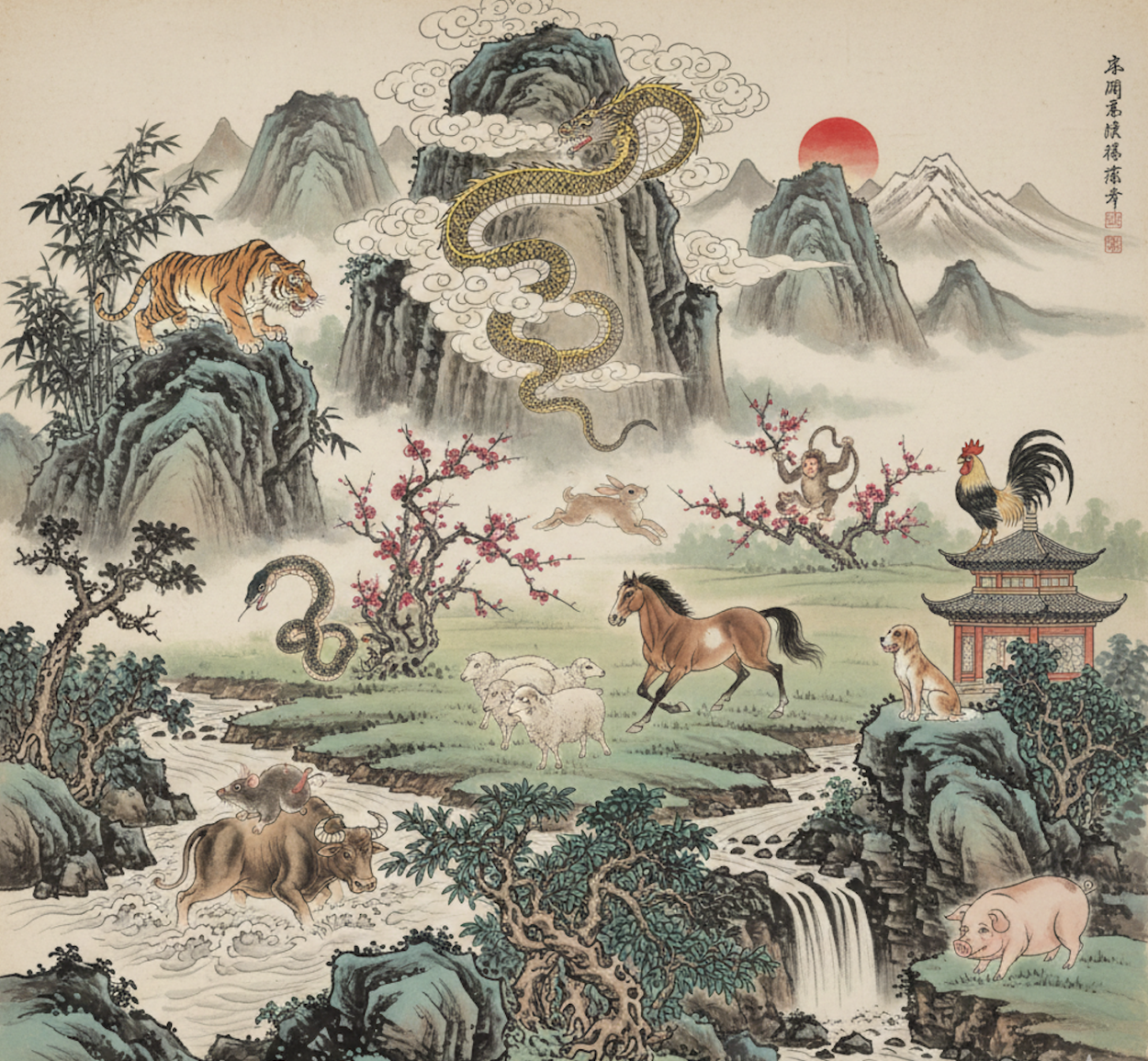
7. Horse – Swift and spirited, the Horse ran a strong race but was outmaneuvered at the final moment. Its placement honors vitality, independence, and an untamed heart.
8. Goat (Sheep) – Gentle and community-minded, the Goat worked in harmony with the Monkey and Rooster to cross on a raft. Cooperation, not competition, carried it forward.
9. Monkey – Ingenious and playful, the Monkey helped build that raft, showcasing problem solving brilliance and irrepressible wit.
10. Rooster – Observant and meticulous, the Rooster spotted the raft solution and rallied the others. Precision and teamwork secured its place.
11. Dog – Loyal and capable, the Dog was an excellent swimmer, but lingered in the water, distracted by play. Its near-last finish reminds us that joy can delay ambition.
12. Pig – Honest and easygoing, the Pig stopped for food and a rest mid-race. Arriving last, it symbolizes contentment and abundance—a gentle reminder that fulfillment need not be hurried.
The order, then, is less a ranking of superiority than a mosaic of virtues: wit, resilience, compassion, collaboration.
Hierarchy or Harmony?
Though often interpreted as a hierarchy, the zodiac is fundamentally cyclical. Each animal rules in turn, every 12 years, within the framework of the traditional Chinese calendar. Power rotates; fortune ebbs and flows. While certain signs, most notably the Dragon, are considered especially auspicious, no animal reigns permanently. The system values balance over dominance, rhythm over rank.
Time, Told in Animals
What gives the zodiac its quiet endurance is its narrative intimacy. Time is not counted in numbers alone but in archetypes—creatures that mirror human strengths and flaws. Across centuries, from imperial courts to modern city skylines, the cycle continues to turn, inviting each generation to locate itself within the story.
In this worldview, time does not simply pass. It returns, furred, feathered, scaled,asking who we are, and who we might yet become.